
1. G73 (chip breaking cycle) is usually used for processing holes deeper than 3 times the drill diameter, but not exceeding the effective blade length of the drill. 2. G81 (shallow hole cycle) is usually used for drilling center holes, chamfering and holes not exceeding 3 times the drill diameter. With the emergence of internal cooling tools, in order to improve processing efficiency, this cycle will also be selected for drilling. 3. G83 (deep hole cycle) is usually used for processing deep holes.
When the machine is equipped with spindle center cooling (water outlet)
When the tool also supports center cooling (water outlet)
Choosing G81 to process holes is the best choice
The high-pressure coolant will not only take away the heat generated during drilling, but also lubricate the cutting edge more timely. The high pressure will also directly break the drill chips. The small chips generated will also be discharged from the hole in time with the high-pressure water flow, avoiding tool wear and quality degradation of the processed hole caused by secondary cutting. Since there is no problem of cooling, lubrication, and chip removal, it is the safest and most efficient solution among the three drilling cycles.
Xinfa CNC tools have the characteristics of good quality and low price. For details, please visit: CNC Tools Manufacturers - China CNC Tools Factory & Suppliers (xinfatools.com)
The processing material is difficult to break chips but other working conditions are good
When there is no spindle center cooling (water outlet)
Using G73 is a good choice
This cycle will achieve chip breaking through a short pause time or a small distance of retraction, but the drill bit needs to have good chip removal ability. A smoother chip groove will allow the chips to be discharged faster to avoid being entangled with the chips of the next drilling, thereby destroying the quality of the hole. Using compressed air as an auxiliary chip removal is also a good choice.
If the working conditions are unstable
Using G83 is the safest choice
Deep hole processing will cause the cutting edge of the drill bit to wear too quickly because it cannot be cooled and lubricated in time. The chips in the hole will also be difficult to be discharged in time due to the depth. If the chips in the chip groove block the coolant, it will not only greatly reduce the life of the tool, but the chips will also make the inner wall of the processed hole rougher due to secondary cutting, further causing a vicious cycle.
If the tool is raised to the reference height -R after drilling a short distance -Q, it may be more suitable when processing near the bottom of the hole, but it will take a lot of time to process the first half of the hole, which causes unnecessary waste.
Is there a more optimized method?
Here are two ways to use G83 deep hole cycle
1: G83 X_ Y_ Z_ R_ Q_ F_
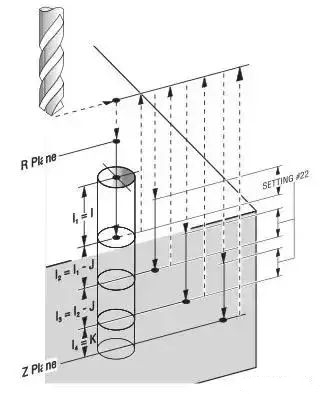
2:G83 X_ Y_ Z_ I_ J_ K_ R_ F_
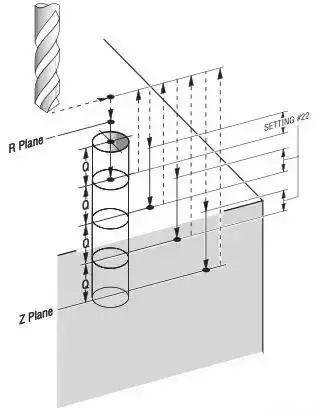
In the first method, the Q value is a constant value, which means that from the top to the bottom of the hole, the same depth is used for processing each time. Due to the need for processing safety, the smallest value is usually selected, which also means the least metal removal rate, and a lot of processing time is wasted invisibly.
In the second method, the depth of each cutting is represented by I, J, and K respectively:
When the working condition at the top of the hole is good, we can set a larger I value to improve processing efficiency;
When the working condition in the middle of the processing hole is average, we use a gradually reduced J value to ensure safety and efficiency; when the working condition at the bottom of the processing hole is bad, we set the K value to ensure processing safety.
In actual use, the second method may increase your drilling efficiency by 50% and cost zero!
Post time: Jul-22-2024


